
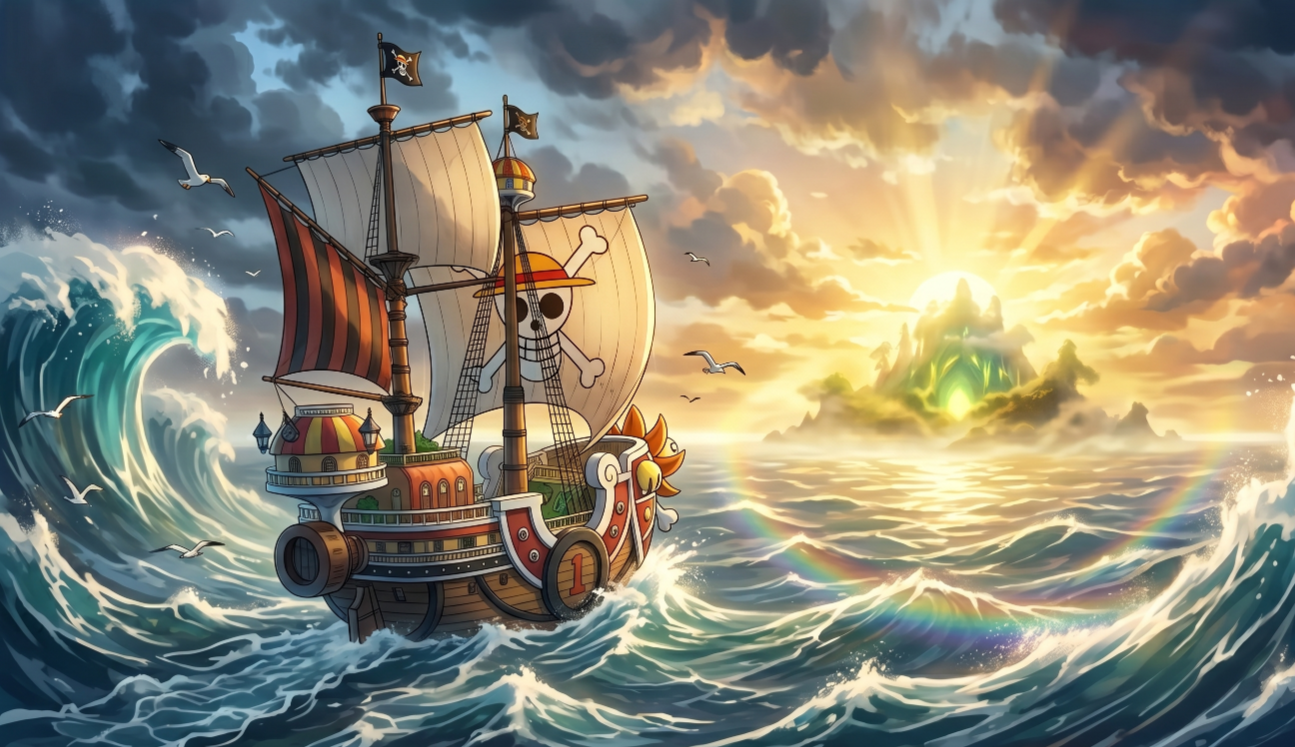
The Grand Line and Beyond: Why One Piece is the Undisputed King of Shonen Anime
In the vast, ever-expanding world of manga and anime, One Piece stands out like a towering ship among smaller boats. For over two and a half decades, Eiichiro Oda’s One Piece has not only survived the changing tides of pop culture but has also dominated them. Since its debut in Weekly Shōnen Jump in 1997, this sprawling pirate adventure has broken sales records, created a global multimedia empire, and captured the hearts of millions across generations.
But for those new to the series, the sheer size of One Piece—with over 1,100 manga chapters and 1,100 anime episodes—can feel overwhelming.
Why would anyone commit to a story that long? The answer lies in the unmatched depth of its world-building, the deep emotional connections with its characters, its complex exploration of freedom versus oppression, and a level of narrative foreshadowing that borders on the prophetic. This is the ultimate guide to understanding the phenomenon of One Piece.
At the core of One Piece’s success is its setting.
The world Oda has created is a geographical and political marvel. The planet is divided by a massive continent known as the Red Line and an equatorial ocean current called the Grand Line. This divides the world into four seas: the North, South, East, and West Blues.
The Grand Line itself is a chaotic, unpredictable stretch of ocean where standard navigation tools fail, the weather can shift from a blizzard to a heatwave in seconds, and monsters lurk beneath the waves.
Here, the greatest pirates, marines, and adventurers clash.However, the world-building extends far beyond geography.
Oda has crafted a dense, living political ecosystem. The world is primarily ruled by the World Government, a massive coalition of over 170 nations, enforced by their primary military arm, the Marines. Standing in opposition are the pirates, especially the "Four Emperors" (Yonko)—the most powerful and notorious pirates who rule the second half of the Grand Line, known as the New World. Adding layers to this are the Revolutionary Army, who seek to overthrow the World Government, and a hidden history known as the "Void Century."
This 100-year gap in recorded history holds the key to the world’s greatest secrets, hidden on indestructible stone blocks called Poneglyphs. Every island the crew visits has its own distinct culture, history, architecture, and political struggles, making the world feel incredibly alive and connected. Actions taken hundreds of chapters ago echo into the present narrative, rewarding long-term readers in a way no other series can match.
The Boy in the Straw Hat: Redefining the Protagonist
At the center of this massive geopolitical web is Monkey D. Luffy, a boy whose body gained the properties of rubber after eating a mystical "Devil Fruit."Luffy’s goal is simple yet seemingly impossible: find the legendary treasure known as the "One Piece," left behind by the late Pirate King, Gol D. Roger, and become the new Pirate King.At first glance, Luffy appears to be a standard shōnen archetype—loud, food-obsessed, and somewhat simple-minded.
However, as the series progresses, Luffy’s true nature is revealed. He is not driven by a desire for conquest, wealth, or even traditional heroism. When asked what it means to be the Pirate King, Luffy simply states that the Pirate King is the person with the most freedom on the sea.
Luffy is a force of nature, a chaotic good who shatters the oppressive structures of the islands he visits, not out of a complex moral philosophy, but because he inherently despises seeing people’s dreams crushed and their freedom stolen.He is the ultimate catalyst for change in a world stagnant with corruption and absolute authority.
Luffy’s journey would be impossible without his crew, the Straw Hat Pirates.
Unlike many series where side characters fade into the background as the protagonist grows stronger, the Straw Hats remain integral to the narrative. Each member is brought onto the ship not just for their combat skills, but for their specific, indispensable role and their deeply personal dreams.
- Roronoa Zoro: The fiercely loyal swordsman who dreams of becoming the world’s greatest swordsman to honor a childhood promise.
- Nami: The brilliant navigator seeking to map the entire world, having freed herself from a childhood of piracy and extortion.
- Usopp: The cowardly sniper who slowly evolves into a brave warrior of the sea, aiming to live up to his father’s legacy.
- Sanji: The chivalrous cook who dreams of finding the "All Blue," a legendary ocean where all the fish in the world gather.
- Tony Tony Chopper: A reindeer who ate a Human-Human Devil Fruit, serving as the ship’s doctor with the dream of curing any disease.
- Nico Robin: The enigmatic archaeologist, the only person alive who can read the Poneglyphs, seeking the true history of the Void Century.
- Franky: The eccentric cyborg shipwright who built their legendary ship, the Thousand Sunny, and dreams of seeing it sail to the end of the world.
- Brook: A living skeleton and musician, bound by a promise to reunite with a giant whale named Laboon after decades of isolation.
- Jinbe: The wise and powerful fish-man helmsman, who fights for equality and peace between humans and his oppressed people.
Their found-family dynamic is the emotional anchor of the series. Oda spends significant time exploring their tragic backstories, making every victory and defeat feel intensely personal.
Themes of Freedom, Oppression, and Inherited Will
While One Piece is known for being silly and adventurous, it also deals with serious and mature topics. The series doesn't avoid showing the terrible aspects of slavery, racism (especially through the Fish-Men's history), government corruption, censorship, and the heavy consequences of war. The World Government, supposed to be the protectors of justice, are often shown to be authoritarian, ready to destroy whole islands of innocent people just to keep their power and secrets.
On the other hand, the story highlights the theme of "Inherited Will." In the world of One Piece, a person's dreams don't die when they do; they pass on to the next generation. The dreams of people, the flow of time, and inherited will are seen as unstoppable forces. This gives the story a deep sense of hope. No matter how strong the forces of oppression are, the dawn will always come.
A Perfectly Balanced Power System
One of the reasons the combat in One Piece stays exciting is because of two main power systems: Devil Fruits and Haki.
Devil Fruits give users incredible powers but take away their ability to swim—a big disadvantage for pirates.They are divided into three types: Paramecia (powers that change the body), Zoan (transform into animals), and Logia (control and transform into natural elements).
To prevent Logia users from being unbeatable, Oda introduced Haki, which is a reflection of a person's will.Observation Haki improves perception and gives a sense of forewarning. Armament Haki lets users create invisible armor that can overcome Devil Fruit abilities. Conqueror's Haki, a rare ability, is only found in those with the mindset of a king and allows the user to overpower others' wills. The mix of strange Devil Fruit abilities and the sheer willpower of Haki leads to creative and strategic battles.
Eiichiro Oda's greatest strength is his ability to plan for the long term.
One Piece is a masterclass in foreshadowing. A simple comment in chapter 100 might become the main plot point in chapter 800. Characters introduced as background figures return years later to change everything. This careful planning has created a huge, highly engaged fan base that loves to guess and analyze every part of the manga.
As the series approaches its final saga, many long-hinted mysteries are finally being revealed—like the true nature of the One Piece, the history of Joy Boy, the events of the Void Century, and the identity of the world's secret ruler, Imu.The payoff for long-time fans is something truly special in the world of comics.
In conclusion, One Piece is a big commitment, but it's one that's worth it.
It makes you laugh in one chapter and cry in the next. It's a lively, chaotic, deeply emotional story about found family, the never-ending chase for freedom, and the bravery to stand up against an unfair world. It shows that the journey is more important than the destination, and in the case of One Piece, it's the greatest journey in modern storytelling.