
The Ultimate Guide to Web Hosting in 2026: Building Your Digital Foundation
The Ultimate Guide to Web Hosting in 2026: Building Your Digital Foundation
In the real world, if you want to start a business, build a home, or open a gallery, you need a piece of land. You need a physical space to store your items, meet your customers, and make your presence known. The online world works the same way, but instead of physical land, you need digital land. This is the basics of web hosting.
Whether you're starting a personal blog, a portfolio, an online store, or a big business website, web hosting is the hidden engine that keeps your online presence running.
As of 2026, the global web hosting market has grown to nearly $180 billion, showing how important this infrastructure has become for our daily lives and the global economy. But what exactly is web hosting? How does it work? With so many providers offering similar services, how do you pick the right one? This detailed guide covers everything you need to know about web hosting.
Understanding How Web Hosting Works:
At its core, a website is a collection of files — HTML code, CSS styles, images, videos, and databases.
These files can't just stay on your personal computer; they need to be stored on a powerful, always-on computer connected to the internet 24/7. This is called a server. When you buy a web hosting plan, you're renting space on one of these servers.
Here’s how it works in real time when someone visits your website:
The Domain Name: A visitor types your website address (e.g., www.yourwebsite.com) into their browser.
Think of the domain name as your address online.
The DNS Lookup: The browser connects to the Domain Name System (DNS), which acts like the internet's phonebook.
The DNS translates your easy-to-read domain name into a numeric IP address, which points to the server where your website files are stored.
The Request and Delivery: The browser sends a request to that server.
The server gets the request, retrieves the necessary files, and sends them back to the visitor’s screen in a matter of milliseconds. If your hosting is good, this happens instantly. If it's poor, your visitors might leave, your sales might drop, and your reputation could suffer.
Why High-Quality Web Hosting Matters:
In the early days of the internet, having a website was enough.
Today, the performance of your website is what determines your success. Choosing a reliable hosting provider affects three key areas of your online presence:
1.Speed and Performance:
In 2026, people have little patience.
Statistics show that nearly 47% of users expect a website to load in two seconds or less. A one-second delay can lead to a 7% drop in conversions. Search engines like Google also penalize slow websites. The speed of your website depends on your hosting provider’s use of NVMe SSD storage, updated server software, and integrated Content Delivery Networks (CDNs).
2.Uptime and Reliability:
Uptime refers to how much time your website is available to visitors.
The standard is 99.9% uptime, but that still means nearly 9 hours of downtime each year. Premium hosts aim for 99.99% uptime. If your server goes down, your website is inaccessible. For an e-commerce site, a few hours of downtime during a busy shopping season can cost thousands in lost sales.
3.Security:
Cyber threats are more advanced than ever, with tens of thousands of attacks happening daily.
A trusted web host acts as your first line of defense. They offer features like SSL certificates (which protect data between the user and the server), automated malware scans, Web Application Firewalls (WAF), and constant DDoS protection.
The Different Types of Web Hosting:
The web hosting industry isn’t one-size-fits-all.
Providers offer various hosting types to meet different needs, traffic levels, technical skills, and budgets. Here’s an overview of the main hosting types available today:
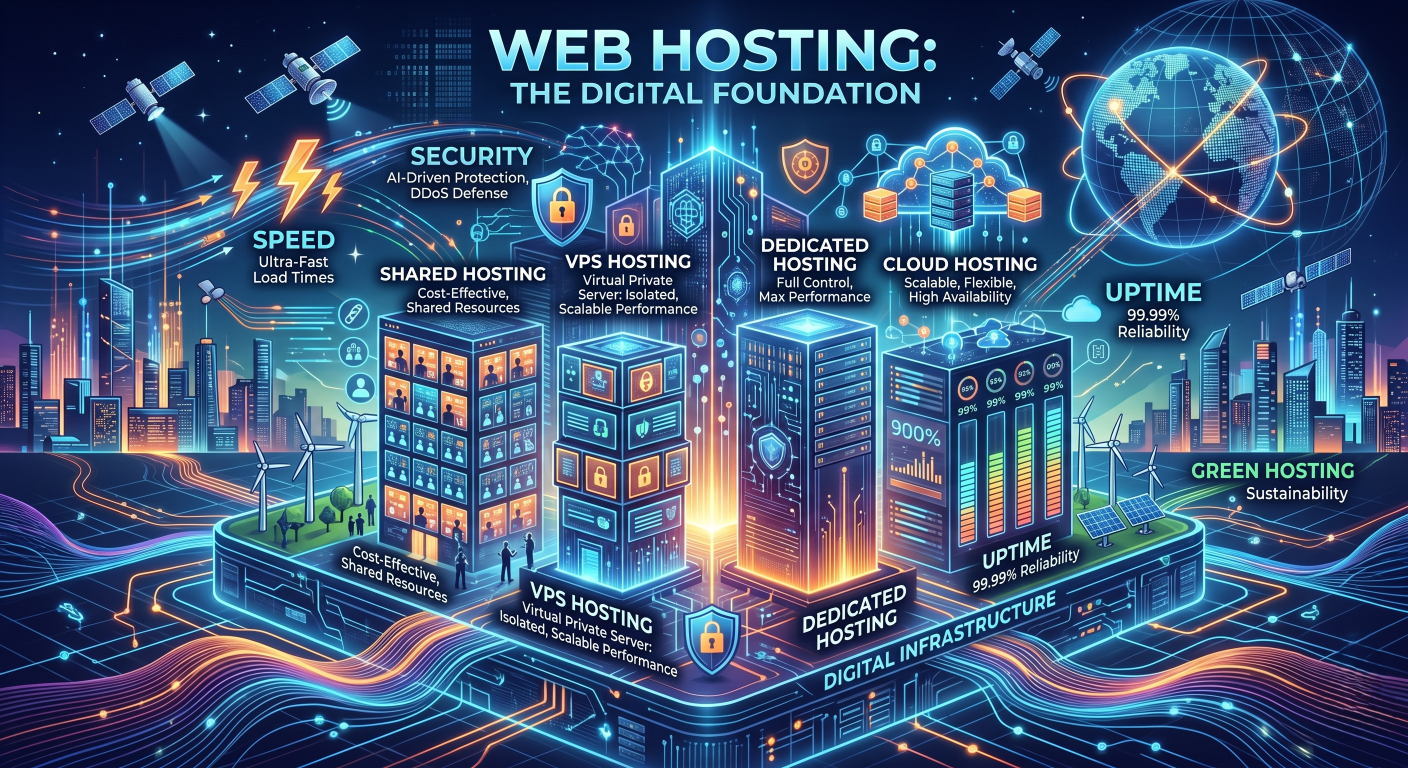
Shared Hosting: The Apartment Complex
Shared hosting is exactly what it sounds like — your website shares a single server with many other websites.
All the server's resources (CPU, RAM, bandwidth) are shared among all the sites.
The Pros: It's very affordable, often costing between $2 to $10 per month, and is great for beginners, usually coming with simple control panels and one-click installations.
The Cons: Because resources are shared, you're vulnerable to "noisy neighbors."
If another site on your server gets a traffic spike or suffers a security issue, it could slow down or crash your website.
Best For: Personal blogs, portfolios, and small local businesses with low to moderate daily traffic.
Virtual Private Server (VPS) Hosting: The TownhouseVPS hosting still shares a physical server, but there's a big difference: it uses virtualization to split the server into separate virtual areas. You are given a part of the server's CPU, RAM, and storage that no one else can use.
Pros: It offers much better performance, stability, and security than shared hosting.
You also get "root access," which means you can customize the server to fit your needs exactly.
Cons: Setting up and managing a VPS needs some technical knowledge, though many providers now offer "managed VPS" where they handle the work for you, but at a higher cost.
Best For: Growing businesses, medium-sized e-commerce stores, and developers who need special software setups.
Dedicated Hosting: The Single-Family Home
With dedicated hosting, you get a whole physical server for your website.
You don't share it with anyone else.
Pros: It provides maximum performance, top security, and full control over everything, from hardware to software.
Cons: It is very expensive, often costing hundreds or even thousands per month.
It also needs advanced IT skills to keep it running smoothly.
Best For: Large enterprise websites, high-traffic e-commerce sites, and applications dealing with sensitive data.
Cloud Hosting: The Interconnected Hotel
Cloud hosting has changed the game.
Instead of using one physical server, your site is hosted on a network of virtual servers that all connect to a large physical setup.
Pros: It offers amazing scalability and reliability.
If one server fails, another instantly takes over, so downtime is almost impossible. You can also quickly add more RAM or CPU during traffic spikes, like a viral post, and only pay for what you need.
Cons: Costs can be tricky to predict since you are charged based on your exact usage.
Best For: Startups growing fast, SaaS platforms, and digital publishers with traffic that changes a lot.
Managed WordPress Hosting
Because WordPress runs over 43% of websites, a special type of hosting, called "Managed WordPress Hosting," has become popular.
This isn't a different server setup (it can be on shared, VPS, or cloud servers), but it’s optimized specifically for WordPress. The host takes care of updates, backups, caching, and security for WordPress.
Key Trends Shaping Web Hosting in 2026
The web hosting world is changing, not staying the same.
As people use the internet more, the supporting systems must also adapt. Here are the big trends shaping web hosting in 2026:
1.The Rise of Edge Computing
In the past, if a user in Tokyo accessed a website on a server in New York, the data had to travel long distances, causing speed issues.
Now, hosting is moving to the "edge." Hosting networks are connected with advanced CDNs that not only store static files but also run code on servers close to the user. This makes websites faster and gives users a smoother experience, no matter where they are.
2.Artificial Intelligence in Server Management
AI is more than just a feature on the front end—it's now part of the hosting system.
Hosting companies are using AI and machine learning for predictive monitoring. These tools look at traffic patterns to predict when resources might run out and automatically scale up to handle the load. On security, AI can detect new malware by spotting unusual activity, not just relying on old virus scans.
3.Sustainability and Green Hosting
Data centers use a lot of energy and water for cooling.
With more focus on the environment, "Green Hosting" has moved from just a marketing idea to a must-have for businesses. Top hosts are moving to renewable energy, making servers more efficient, and investing in eco-friendly programs. Large companies now want their web hosts to match their sustainability goals.
4.Hybrid and Multi-Cloud Environments
We're moving away from using just one provider.
Big websites are using a mix of cloud services and on-premise systems. This means dividing work between different cloud platforms like AWS and Google Cloud, and local servers. This setup helps reduce costs, improves backup options, and lets developers pick the best tools from different providers.
How to Choose the Right Web Host
With a clear understanding of the technology and market, how do you pick the best web host for your needs?
Choosing a host comes down to asking the right questions about your current situation and future plans.
Assess Your Resource Needs: Think about how much traffic your website will get.
For a brand new blog, shared hosting might be enough. But if you're moving an existing WooCommerce store with 50,000 monthly visitors, you’ll need VPS or Cloud hosting. Don’t pay more for resources you don’t use, but also avoid under-provisioning and risking your site crashing.
Evaluate the Support Quality: This is where many cheap hosts fall short.
If your website crashes at 2:00 AM on a Sunday, you need fast help. Look for hosts that offer 24/7/365 support through live chat and phone. Check reviews to make sure their support team is actually helpful, not just reading from scripts.
Review the Security Features: Ensure the host includes a free SSL certificate (usually through Let's Encrypt).
Check if they offer daily backups and how easy it is to restore them. A good host will also be open about their firewalls and security measures.
Consider Scalability: Your goal is to grow.
The best web host is one that can grow with you. Look for providers that let you upgrade from shared hosting to VPS or Cloud hosting without having to do time-consuming, manual site moves.
Look Past the Introductory Price: The web hosting industry is known for offering big discounts on the first year, but then charging much more later.
Conclusion
Web hosting is the unseen foundation of the digital economy.While it's easy to focus on the look of a website or the tactics of digital marketing, none of those efforts matter if your digital base is shaky, slow, or unsafe.As we move into 2026, the technology behind web hosting has become more advanced than ever.It uses AI, edge networks, and green energy to bring content to people around the world in just milliseconds. By understanding the different hosting options and matching them to your business needs, you can make sure your online space stays open, safe, and ready for whatever comes next on the internet.