
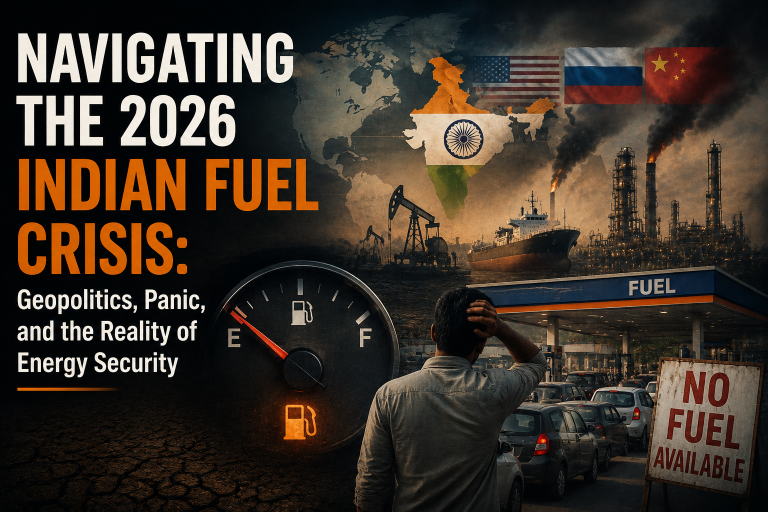
Navigating the 2026 Indian Fuel Crisis: Geopolitics, Panic, and the Reality of Energy Security
Navigating the 2026 Indian Fuel Crisis: Geopolitics, Panic, and the Reality of Energy Security
In the spring of 2026, the phrase "Energy Lockdown in India" became a hot topic on social media, messaging groups, and evening news. In cities like Ahmedabad, Hyderabad, Surat, and Rajkot, people stood in long lines at petrol stations, waiting for hours to get fuel. Everyone was worried: a big fuel shortage might happen, and it could stop the country's fast-growing economy from working properly. However, behind all the videos showing empty fuel pumps and people rushing to buy fuel, there was a more complicated truth. The so-called fuel shortage wasn't because there wasn't enough fuel in the country. Instead, it came from serious global political tensions, local panic buying, and a big financial problem in India's state-controlled oil companies. This article looks at the 2026 fuel crisis in India. It separates the real facts about India's energy situation from the fear that took over the country and checks the economic effects that led to the first big fuel price increase in over four years.
The main cause of this panic was the war in West Asia, especially in the Persian Gulf.
The main trigger for India's worry was the big conflict between Iran, Israel, and the US. The Strait of Hormuz became the center of global fear. This narrow waterway between the Persian Gulf and the Gulf of Oman is a key point where most of the world's oil passes through. As the conflict turned more serious, the risk of stopping ships in this area caused big changes in the global oil market. Ship delays, expensive insurance for oil tankers, and a big jump in oil prices followed.
For India, which gets over 80% of its oil from outside the country, this was a big problem. Although India has been working to get oil from other places, like Russia, the Middle East is still very important for a type of fuel called Liquefied Petroleum Gas (LPG). When people realized their main supply line was in danger, it caused a lot of worry.
The fear almost made the shortage happen by itself.
In March and April 2026, false news spread online, saying India only had a few days of fuel left and that the government was about to start an "Energy Lockdown." This would involve strict limits on fuel use, like odd-even vehicle rules, similar to what some other countries have done during emergencies. The effect was fast. People rushed to buy fuel, which made the demand much higher than usual. This sudden increase overworked the fuel distribution system. Fuel stations that usually had a steady stream of customers suddenly got too many people. When a few busy stations ran out of fuel before the delivery trucks arrived, pictures of "Closed" signs became popular online, making things worse.
In reality, the shortage was just a problem with how fuel was being moved, not a real lack of fuel. There was plenty of fuel in the big storage areas run by the oil companies, but it couldn't be moved fast enough to meet the rush caused by panic buying. To stop the public from getting too worried, the Indian government started a strong communication effort.
The Government's Response: Clarification and Strategic Reserves
The Ministry of Petroleum and Natural Gas, led by Hardeep Singh Puri, and the Informal Group of Ministers (IGoM), led by Rajnath Singh, talked a lot about the country's fuel reserves. They said there was no real shortage. They revealed that India had enough fuel to last 60 to 69 days, plus 45 days of LPG supply. They called India an "oasis of energy security," noting it was the world's fourth-largest refiner and sent refined products to over 150 countries. Every refinery was working more than full capacity. The government also said that while other countries had to cut back on fuel, India's supply chain stayed strong. To deal with LPG concerns, which were affected by ships stuck in the Persian Gulf, they increased domestic LPG production from 36,000 tonnes to nearly 54,000 tonnes.
PM Modi's Call for Austerity
While the fuel supply was still secure, the cost of keeping it going was becoming extremely high. Aware of the growing financial pressure on the country, Prime Minister Narendra Modi asked all citizens to help save the Indian economy by being more careful with their resources. In a major speech, he told people to use public transport, carpool, and return to working from home, similar to what was done during the pandemic. He also asked people to stop non-essential trips abroad and to avoid buying gold for a whole year, to protect the country’s foreign currency reserves.
The main issue was clear: India had enough fuel, but buying it from the global market at very high prices was draining the country’s wealth and hurting state oil companies.
The Silent Hemorrhage: The Plight of the OMCs
The real problem in 2026 wasn’t a lack of fuel, but a financial crisis. For over four years, the price of petrol and diesel at fuel pumps had stayed the same. Despite everything — a global pandemic, elections, inflation, and wars — the government kept the prices frozen to protect consumers from the ups and downs of international oil prices. This helped people save money, but it also burdened the state-owned oil companies.
When the cost of crude oil rose past $113 per barrel in April 2026, these companies had to sell fuel at huge losses. They were losing about Rs 14 per litre on petrol, Rs 42 per litre on diesel, and Rs 674 per domestic LPG cylinder. In total, these companies were losing Rs 1,000 to Rs 1,200 crore each day. Officials warned that if prices stayed high and retail prices remained frozen, the losses in the first quarter of the 2026-2027 financial year could erase all the expected profits of these companies. The situation was unsustainable. The government had already cut excise duties, losing around Rs 14,000 crore a month. There was no more room to help the oil companies.
The Breaking Point: The May 2026 Price Hike
Everything changed on May 15, 2026.
With major state elections in Assam, Kerala, Tamil Nadu, and West Bengal completed, the political environment shifted, and the economic reality could no longer be ignored. On that day, the three state-run oil companies — Indian Oil Corporation (IOCL), Bharat Petroleum (BPCL), and Hindustan Petroleum (HPCL) — announced a sudden price increase of Rs 3 per litre on both petrol and diesel. It was the first price rise in over four years. Overnight, petrol prices in Delhi jumped to Rs 97.77, while in cities with higher taxes like Mumbai, Kolkata, and Chennai, prices crossed Rs 100, reaching between Rs 103 and Rs 108 per litre.
The political backlash was fast and strong. Opposition parties immediately accused the government of keeping prices low just to gain votes and then punishing people once the election ended. Critics also pointed out the wider impact on inflation, transportation costs, and the economy. They argued that when crude prices were low in the past, the government didn’t pass on the savings to the public but instead collected more taxes.
The Ground Reality and the Path Forward
For the average Indian, the 2026 crisis meant a bigger burden on their daily expenses, not an empty fuel tank. While the government managed to avoid a real shortage by building up reserves and securing safe passage for ships through the Persian Gulf, the cost of living had clearly gone up. Delays in LPG cylinder deliveries and rising black market prices in some areas showed the weaknesses in the last-mile distribution system during crises.
The 2026 fuel crisis was a turning point for India’s energy strategy. It showed how risky it is to rely heavily on oil imports from unstable regions. Although India’s reserves helped, holding 60 days of oil is just a temporary fix, not a long-term solution.
After the crisis, the need to move towards energy independence has never been clearer The government’s efforts to boost domestic exploration, expand solar and wind energy, adopt green hydrogen, and electrify the transport sector are not just environmental goals — they are vital steps for national economic security. Until India can reduce its dependence on the global crude oil market, the shadow of future energy crises will always be a threat.