
The NEET 2026 Paper Leak: A Crisis of Trust, Examination Integrity, and the Future of Medical Aspirants
The NEET 2026 Paper Leak: A Crisis of Trust, Examination Integrity, and the Future of Medical Aspirants

Introduction: The Gravity of India's Medical Gateway
The National Eligibility cum Entrance Test (Undergraduate), commonly known as NEET-UG, is not just a test; it is the only high-stakes entrance for admission into medical and dental undergraduate courses across India.
For the 2026 academic year, more than 22 lakh aspiring students registered for the exam, all vying for a very limited number of government MBBS seats. Over the years, students have sacrificed their social lives, families have invested their life savings in coaching institutes, and the pressure to succeed has reached unimaginable levels.
Given the high stakes, the integrity of the NEET examination is of utmost importance. However, the events that took place in May 2026 have shaken the trust of millions. Nearly two years after the controversies of 2024, the specter of compromised exams has returned, casting a shadow over the nation. The cancellation of the May 3, 2026, examination due to a verified paper leak is not just an administrative mistake; it is a major academic and political scandal that exposes the serious weaknesses in India's centralized exam system.
The Timeline of the Crisis: From Assurances to Cancellation
The build-up to the May 3 examination was filled with rumors about compromised papers.
On May 1, just two days before the test, the National Testing Agency officially dismissed the circulating claims of a question paper leak, warning students against believing false information on platforms like Telegram and WhatsApp. The NTA assured the public that the exam environment was secure and that they were monitoring all illegal activities.
On May 3, the exam was conducted across thousands of centers under what the NTA claimed were "full security protocols." However, the illusion of a fair test quickly disappeared. By May 7, the NTA received credible information from law enforcement regarding malpractice. Recognizing the gravity of the situation, the agency reported the matter to central authorities on May 8 for independent verification. Finally, on the evening of May 12, the NTA issued a public notice confirming the worst nightmare for every honest aspirant: the NEET-UG 2026 examination was entirely cancelled to safeguard the credibility of the national examination system.
Anatomy of the "Guess Paper" Leak
The 2026 leak revolves around a carefully shared document pretending to be a "guess paper" or a "suggestion bank."
Investigations by the Rajasthan Special Operations Group (SOG) found that a PDF document containing approximately 410 handwritten questions was being distributed to students weeks before the exam. The origin of this digital trail was traced back to an MBBS student from Kerala, who allegedly sent the document to a friend and a hostel owner in Sikar, Rajasthan—a rapidly growing center for competitive exam coaching. The hostel owner, pretending to offer helpful study material, shared the password-protected PDF with many students staying in his hostel.
The full extent of the compromise became clear when investigators compared the "guess paper" with the actual May 3 question paper. Officials found remarkable similarities: about 120 questions matched exactly with the real exam. Breaking it down, this included nearly 90 questions from the Biology section and 30 from Chemistry. In an exam where every mark determines one's national rank, having access to 120 exact questions—representing around 600 out of the total 720 marks—completely destroyed the fairness of the competition.
Tracing the Interstate Syndicate
While the immediate distribution happened in Rajasthan, the CBI investigation found a deeply rooted interstate syndicate behind the breach. The geographical spread of the leak shows the weaknesses in how exam materials are physically handled. According to investigative reports, the leak started far from Rajasthan's coaching centers. The paper was allegedly tampered with at a secret printing press in Nashik, Maharashtra. From there, a hard copy was reportedly intercepted and sent via courier to an accused person who took photos of the pages. The digital files were then sent to a key suspect—an individual based in Gurugram, Haryana.
The paper continued its illegal journey from Gurugram to Jamwa Ramgarh in Rajasthan, where two brothers allegedly bought the leaked material on April 26 for a huge amount of ₹30 lakh. From this key point, the question bank moved to Sikar. As it spread through the distribution network, the price dropped, but more buyers came in. Students questioned by investigators said they paid between ₹2 lakh and ₹5 lakh to get access to handwritten and scanned PDF copies of the exam papers days before the test. The network eventually reached candidates in Jammu and Kashmir, Bihar, Kerala, and Uttarakhand.
The Paradox of Examination Security
The 2026 leak has revealed a big problem in the NTA's security system. The agency often promotes its advanced technology. For the May 3 exam, the NTA said the question papers were moved in GPS-enabled vehicles, had unique, trackable watermarks, and were monitored using AI-assisted CCTV cameras from a central control room. Candidates had to go through strict biometric checks, and 5G signal jammers were used to stop electronic cheating. Yet, all these expensive, high-tech measures were useless because of a low-tech flaw: the printing and transportation of materials weeks before the exam. A compromised worker at the printing press, a courier interception, handwritten copies, and the use of smartphone cameras and encrypted messaging apps bypassed every digital defense the NTA had in place. It shows that securing the exam hall doesn't matter if the test itself isn't properly protected.
Political Fallout and Nationwide Backlash
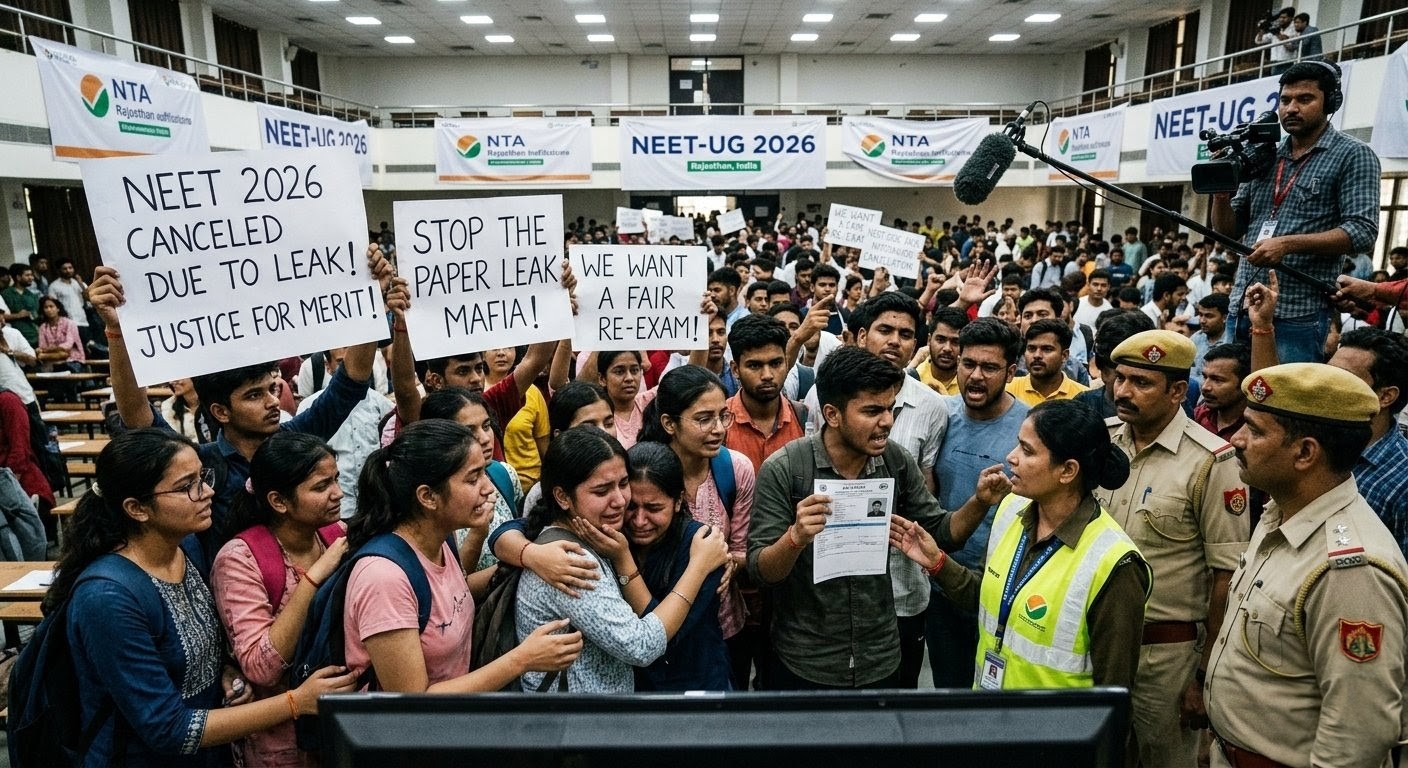
The cancellation of India's biggest medical entrance exam has caused a major political and social reaction. Student groups, especially the National Students' Union of India (NSUI), organized protests at Shastri Bhavan in New Delhi and other state capitals, demanding strict action against the culprits and major reforms.
The political opposition quickly criticized the government's handling of education. Rahul Gandhi, the Leader of the Opposition in the Lok Sabha, used social media to say the administration's promised progress for the youth had turned harmful. He compared the compromised exam process to a corrupt auction where the future of hardworking students is sold to the highest bidder on messaging apps. The medical community has also strongly criticized the authorities, pointing out the repeated failure to stop such leaks despite strict anti-cheating laws.
The Toll on the Aspirants
Beyond the politics and police investigations, there's a serious human cost to the NEET 2026 scandal. For the 22 lakh teenagers who took the exam, the cancellation is a big emotional blow. Students who studied honestly are now suffering from severe "merit fear"—the feeling that their hard work was undone by those who just bought their way to perfect scores.
Additionally, the chance of a re-exam causes a lot of stress. Students who had prepared well for May 3 now have to go through another intense study period while dealing with burnout. Families also face a financial burden by continuing to pay for accommodation, food, and coaching while waiting for new exam dates. The academic calendar has completely fallen apart; the Medical Counselling Committee (MCC) can't move forward with seat allocations, so the start of the first-year MBBS curriculum will be delayed in all Indian medical colleges.
The Road Ahead: A Call for Structural Reform
The NTA has confirmed a re-examination will take place, promising that existing registration data and test centers will be used, and no extra fees will be charged. The new exam schedule and admit card dates will be announced separately. However, a simple re-test is only a temporary fix for a big system problem. The 2026 crisis has reignited urgent discussions about the need for structural reform in how India runs high-stakes exams.
Experts are now pushing for a move away from the weaknesses of using paper-based, offline exams. Switching to a fully digital, Computer-Based Test (CBT) format, like the Joint Entrance Examination (JEE) for engineering, could help reduce the dangers linked to physical printing, manual delivery, and transporting exams across different locations. Also, there's a strong need for creating question banks using algorithms, where different sets of questions, all equally challenging, are made on the spot for each candidate on their screen. This would make it almost impossible for large-scale exam leaks to happen.
Conclusion
The NEET-UG 2026 exam leak is a dark moment in India's educational history. It shows how far organized crime groups will go to take advantage of the stress and pressure students and parents face in a highly competitive academic system. As the CBI continues to investigate and uncover all parts of this illegal network, the responsibility now falls on the Government of India and the National Testing Agency to go beyond just punishment. To restore lost trust among young people, there needs to be complete transparency, strict accountability, and a major change in the exam system. Until the basic problems in the testing process are fixed for good, the future of India's medical profession is in serious danger.