
Taking Back Jantar Mantar: The Gen Z Rebellion Against a Broken System
Taking Back Jantar Mantar: On the Ground with the Students Risking Everything in Delhi
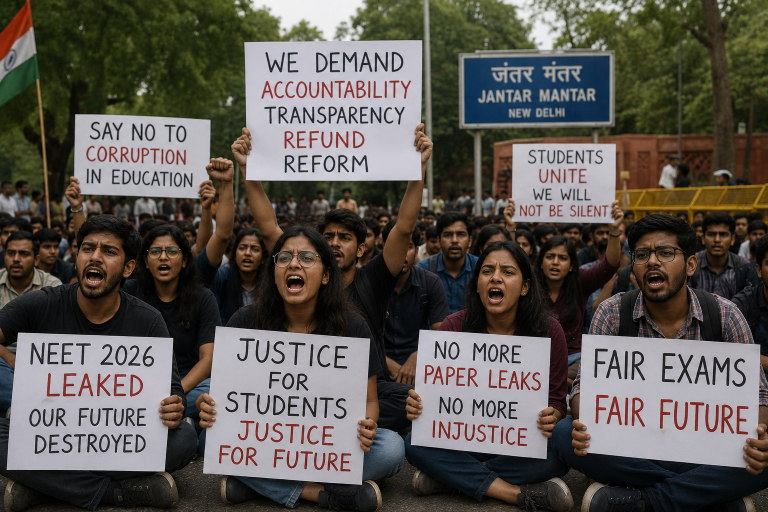
If you walk down Jantar Mantar Road right now, the first thing that hits you isn't a dramatic political speech. It’s the sheer noise—a chaotic blend of cheap megaphones feedbacking, water bottles clinking against barricades, and teenagers yelling into phone cameras to update their Telegram channels.
The pavement is covered in blue plastic tarps. Sitting on them are thousands of nineteen- and twenty-year-olds, their clothes soaked through with monsoon sweat, passing around paper cups of lukewarm tea and splitting packets of biscuits. They aren't professional agitators or veteran union organizers. Most of them are kid doctors and engineers who, up until a month ago, had never stood in front of a police line in their lives.
They are here because they feel like they’ve been robbed. And honestly, it’s hard to argue with them.
How a Three-Hour Exam Sparked a Mass Rebellion
To understand why thousands of young people are sleeping on the street in late July, you have to look at what happened with the 2026 NEET exams and the recent CBSE scoring mess.
In India, competitive exams aren't just tests. They’re the only ticket out for middle-class and working-class families. Thousands of kids pack into tiny, windowless rooms in coaching hubs like Kota, Patna, or Mukherjee Nagar. They cut off their friends, give up sleep, and study 14 to 16 hours a day for three years straight. Their parents take out high-interest loans, sell family land, or drain their life savings just to pay tuition fees.
Then came the news: the NEET paper had been leaked and sold on Telegram for a few lakh rupees days before the test. On top of that, computerized scoring glitches ruined thousands of CBSE results.
If you put your entire life on hold for three years, only to find out the test was rigged before you even picked up a pencil, you don't just get upset. You lose all faith in the system. That's what brought these kids to Delhi. They aren't asking for special treatment or easy passes—they just want a test where money doesn't buy the answer key.
Memes, Hunger Strikes, and "Cockroaches"
The way this movement organized is pure Gen Z. The group driving a lot of the ground protest calls itself the Cockroach Janta Party (CJP), started by youth activist Abhijeet Dipke.
It sounds like a joke, but the logic behind the name is pretty dark. The students say the government treats them like cockroaches—pests you can ignore, spray with water cannons, or sweep away whenever they become inconvenient. So they took the name, made memes out of it, and used it to mobilize hundreds of thousands of people online and offline.
Things escalated rapidly when veteran activist Sonam Wangchuk joined them in late June and went on an indefinite hunger strike. When his health deteriorated in mid-July and he ended up in the hospital, it didn't shut the protest down like authorities probably hoped. Instead, it lit a fire under the students. They stepped up, took over the microphones, and kept the camp running themselves.
Their core demands are straightforward:
- Education Minister Dharmendra Pradhan needs to step down over the administrative failure.
- A completely independent, non-governmental audit of the national examination board.
- Real financial compensation for families affected by the leaks and delayed schedules.
Clashes, Cameras, and Degrees on the Line
Things got ugly on July 20. The students tried to march toward Parliament for a demonstration they called Sansad Chalo. They ran straight into heavy police blockades, heavy-handed lathi charges, and tear gas.
Over 60 students ended up in the hospital, and dozens were hauled off in police vans. One 21-year-old student, Sakshi, was crushed in the rush during the baton charge and spent days in the ICU on a ventilator. She's stable now, but pictures of her in the hospital bed circulated through every student WhatsApp group in the country, turning quiet observers into active protesters overnight.
Since the clash, the state’s response has shifted from heavy force to intense monitoring. The Delhi Police installed Facial Recognition System (FRS) cameras right at the entrance of the protest alley. Walking in feels like entering a high-security zone.
At the same time, universities are trying to choke off the crowd. Delhi University issued an official notice warning students that if they are spotted at Jantar Mantar, they could face disciplinary action that could ruin their academic records. It’s a direct pressure tactic: go home and stay quiet, or kiss your degree goodbye.
Yet, every afternoon, the crowd gets bigger anyway. When you ask students if they’re scared of losing their seats, the answer is almost always the same: What seat? The system already took it from us.
The View from the Street
As night falls over the capital, the scene doesn't quiet down. Portable floodlights hum on generators, casting harsh white light over handwritten signs taped to barricades. Volunteers from local gurdwaras arrive with buckets of warm food, feeding kids who haven't had a proper meal in days.
In one corner, a group of girls are sitting on a tarp, arguing about the latest updates from the negotiation table where CJP representatives met with government ministers at Vithal Patel House. Right next to them, a guy is holding a flashlight so his friend can read a medical textbook—because even while protesting a broken exam system, the fear of falling behind on studies never really leaves.
This isn't a political rally where people were bused in for cash and a lunch box. It’s raw, messy, exhausted, and completely real.
The government keeps treating this like an administrative headache that will blow over once the monsoon season ends and classes resume. But sitting on the pavement at Jantar Mantar, watching these kids share dry rotis and plan their next march, you get the distinct feeling that they aren't going anywhere until something fundamental changes.