
The Boiling Point: India’s Escalating Heatwave Crisis
The Boiling Point: India’s Escalating Heatwave Crisis
By May 2026, the arrival of summer in India no longer just signals a change in wardrobe or diet; it marks the onset of a grueling, months-long survival test for hundreds of millions of people. As the mercury steadily climbs past 44°C in capital cities like New Delhi, and power grids strain under the unprecedented surge in cooling demand, the narrative around Indian summers has fundamentally shifted. Extreme heat is no longer a temporary inconvenience; it is a systemic crisis. Historically, the subcontinent has always endured hot pre-monsoon periods. However, the last decade has fundamentally rewritten the climate record books. Spring seasons are increasingly characterized by distinct, relentless sequences of hot extremes, often beginning as early as February. These protracted thermal events scorch the earth, evaporate vital water reservoirs, and push human physiology to the absolute breaking point.
Defining the Danger: How the IMD Measures a Heatwave
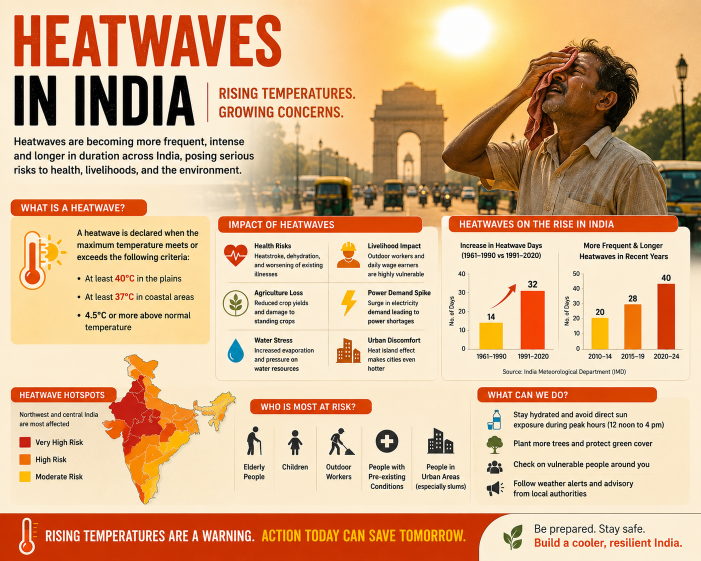
To prepare for disasters and warn people about health risks, the India Meteorological Department (IMD) uses strict scientific rules to declare a heatwave. Since India has such a wide variety of landscapes—ranging from the high Himalayas to the large coastal plains—it’s not possible to use the same temperature standard everywhere. Instead, the IMD sets different base temperatures depending on the region’s geography.
For a heatwave to be considered, a weather station first needs to record a base maximum temperature:
- Plains: At least 40°C.
- Coastal Areas: At least 37°C.
- Hilly Regions: At least 30°C.
Once these base temperatures are met, the IMD looks at the Departure from Normal, which means how much hotter it is compared to the usual temperature for that day and place:
- Heat Wave: The maximum temperature is 4.5°C to 6.4°C higher than the normal.
- Severe Heat Wave: The maximum temperature is more than 6.4°C higher than the normal.
In the plains, a heatwave is automatically declared if the actual temperature reaches 45°C, and a severe heatwave is declared at 47°C, regardless of the usual temperatures. To avoid false alarms caused by short-term temperature spikes, these conditions need to be met at two or more weather stations in a meteorological area for at least two consecutive days.
The New Threat: Humidity and the Wet-Bulb Limit
Although the IMD’s temperature rules are important for places like the dry northwestern states, they can miss the real danger in coastal and southern parts of the country.A temperature of 36°C might not be enough to trigger a heatwave warning under the old rules, but if the humidity is around 80%, the strain on the body is extremely serious.
To solve this problem, the IMD has started using percentile-based thresholds.
Under this new system, a heat alert is issued when maximum temperatures go beyond the 95th percentile for a place—meaning the temperature is higher than 95% of all past records for that area. This helps the department warn about dangerous, humid heat even if the actual air temperature hasn’t reached 40°C.
This brings us to the most important measure for survival in today’s climate: the wet-bulb temperature.
The human body cools down mainly through sweat evaporating from the skin. As sweat turns into gas, it removes heat from the body. But when the air is very humid, it’s already full of moisture, and sweat can’t evaporate anymore.
The wet-bulb temperature shows how much heat and humidity are in the air and how well the body can cool itself. When the wet-bulb temperature is between 31°C and 35°C, the body can’t get rid of heat anymore. Core body temperatures start to rise rapidly, leading to heat exhaustion, organ failure, and in the worst cases, death, even for healthy people resting in the shade.Defining the Danger: How the IMD Measures a Heatwave
The Drivers of Extreme Heat
The increasing frequency and strength of these extreme heat events are not caused by just one thing. Instead, they result from a combination of global climate changes and local environmental damage.
1.Human-Induced Climate Change
The main cause of this problem is global warming. A recent study by World Weather Attribution found that human activities have made the extreme heatwaves that happened before the monsoon season in 2026 about three times more likely. Additionally, these heat events are now about 1 degree Celsius warmer than they would have been in the past, before industries started polluting the atmosphere. This overall rise in temperatures means that the hottest parts of summer are now reaching dangerous levels that have never been seen before.
2.Meteorological Stagnation
Heatwaves are usually caused by high-pressure weather systems that get stuck over a certain area. These systems act like a giant invisible lid, pushing air downward. As the air moves down, it gets compressed and becomes warmer. This cover also stops clouds from forming, letting sunlight hit the ground without any break. This adds to the intense heating. Moreover, weak Western Disturbances—weather patterns that usually bring cooler rain during spring in northern India—have been less frequent in recent years, making the heat even worse.
3.The Urban Heat Island (UHI) Effect
While rural areas suffer, India’s growing cities are especially bad at trapping heat. The Urban Heat Island effect happens when natural land like trees, lakes, and soil is replaced by buildings, roads, and concrete. These materials soak up the sun's heat during the day and slowly release it at night. As a result, cities stay warm much longer after sunset, making it harder for people to cool down. Also, the widespread use of air conditioning creates a problem: these systems push out a lot of hot air into the streets, increasing the temperature for everyone.
Cascading Impacts: Society, Economy, and Agriculture
The effects of long-lasting heatwaves go beyond just the weather. They harm public health, hurt economic activity, and threaten food supplies.
A Public Health Emergency
When the temperature rises quickly, it puts a lot of stress on the body. The heart has to work harder to cool the body by sending more blood to the skin. This constant heat stress leads to a big increase in deaths from heart and kidney problems. Moreover, warm nights are just as harmful as hot days because they stop the body from cooling down, making people feel more exhausted over time.
Thermal Justice and the Informal Workforce
This crisis hits different groups in unequal ways. For the wealthy, extreme heat is just an annoyance they can manage by moving between air-conditioned homes and offices. But for India’s huge informal workforce—nearly 400 million people working in fields, construction, street vending, and logistics—the heat is unavoidable.
This brings up the idea of Thermal Justice. For these workers, stepping out of the sun means losing wages for the day. Global health reports say that billions of work hours are lost each year due to heat stress. When the temperature reaches 34 degrees Celsius, manual workers can lose up to half their work ability. The lack of strong rules to protect these workers means the poorest and most vulnerable people are left exposed to life-threatening conditions just to make a living.
Agricultural Devastation
Heatwaves hit just when important farming seasons are ending. High temperatures during the grain-filling stage of winter-sown crops like wheat and mustard cause the crops to ripen too early, which greatly reduces the amount of food produced.
As the temperature gets higher, the amount of water lost through evaporation and plant transpiration increases a lot. Soil moisture disappears quickly, so farmers have to dig deeper and more often to get groundwater. This speeds up the use of important underground water sources, leading to serious water shortages as the summer continues and the monsoon season approaches.
Adapting to the Furnace: Heat Action Plans
Knowing that heatwaves are going to be a regular part of the future, local and state governments in India have started creating Heat Action Plans (HAPs). These plans were first introduced by Ahmedabad in 2013 and are complete strategies meant to reduce deaths related to extreme heat.
A strong HAP works in several ways:
- Early Warning Systems: Using forecasts from the India Meteorological Department (IMD) to send text messages and make public announcements several days before a heatwave happens.
- Healthcare Preparedness: Making sure hospitals have supplies like ice packs, IV fluids, and oral rehydration salts, and setting up special wards for heatstroke.
- Public Infrastructure Adjustments: Keeping public parks open longer, putting up free drinking water stations, and changing school and outdoor work hours to avoid the hottest times of the day, from 12 PM to 4 PM.
The Roadblocks to Implementation
Even though these HAPs can save lives, many are not fully in place. One big problem is a lack of enough money. Because heatwaves are not seen as traditional disasters like cyclones or floods (which damage buildings), they often don't qualify for national disaster relief funds.
Moreover, many cities have poor teamwork between different groups. Health departments, city governments, and disaster management agencies usually work separately, which slows down important actions.
Long-Term Mitigation: Rebuilding for Resilience
Early warnings and water stations are just quick fixes. To truly survive, Indian cities need a big change in how they are built.
Urban planning should focus on Nature-Based Solutions.
This includes increasing green spaces in cities, protecting and restoring wetlands (which naturally cool the area), and putting "Cool Roof" programs in place. By painting roofs with reflective white materials, buildings absorb less heat, lowering indoor temperatures by up to 5 degrees without using electricity.
India also needs to create comprehensive Heat-Safety Laws. Requiring rest breaks, shaded work areas, and stopping construction during the hottest parts of the day are not just about workers' rights—they are basic human rights in a world that is getting warmer. The climate has changed forever; the systems that protect people must change just as quickly.