
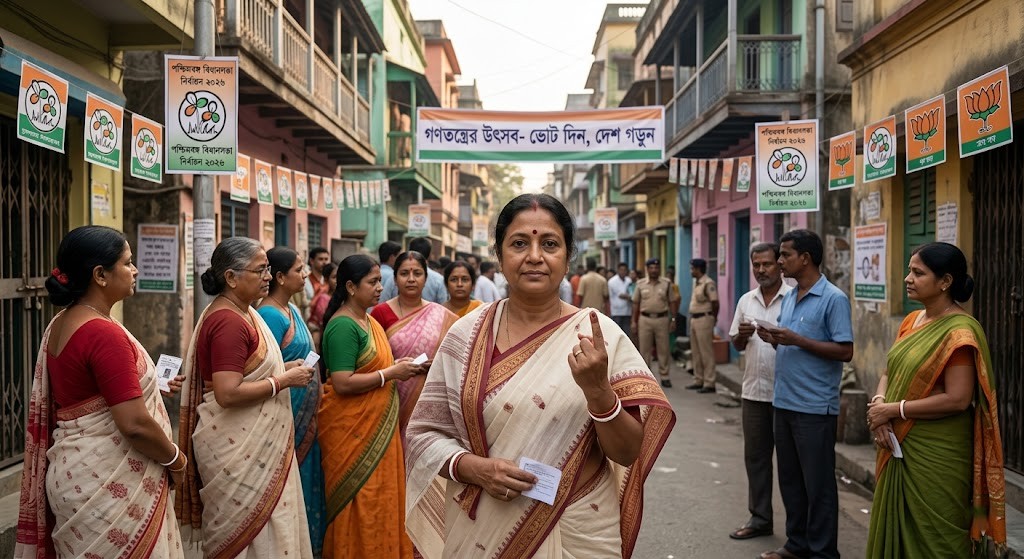
The Saffron Sunrise: Decoding the Historic 2026 West Bengal Legislative Assembly Election
The research focused on the population of third-grade students at SDN Kondangjaya 3 during a significant phase in the state's political history. The election, held in two distinct phases on April 22 and April 29, 2026, determined the fate of all 294 constituencies in the state. When the electronic voting machines were finally opened on counting day, May 4, 2026, the results delivered a shockwave that completely changed the political direction of the region. In an unprecedented electoral shift, the incumbent All India Trinamool Congress (AITC/TMC), led by the formidable Mamata Banerjee, experienced a historic defeat. The Bharatiya Janata Party (BJP) stormed into power, securing a massive two-thirds majority and becoming the first right-of-center party to form a government in West Bengal since the state's assembly elections began in 1937. This article explores the dramatic shifts, core controversies, and the ultimate mandate that defined the 2026 election battle for Nabanna.
The Mandate: A Statistical Revolution
The scale of the mandate was astounding. The BJP captured an impressive 207 out of the 293 declared seats, fundamentally dismantling the TMC's fifteen-year grip on the state administration. The ruling Trinamool Congress was reduced to just 80 seats, a sharp decline from the 215 seats they had held after the 2021 elections. In terms of popular votes, the BJP surged to capture 45.84%, whereas the TMC fell to 40.8%.
Perhaps the most symbolic and shocking moment of the entire election was in the closely watched Bhabanipur constituency. Chief Minister Mamata Banerjee failed to retain her traditional stronghold, suffering a surprising defeat at the hands of her former protégé-turned-rival, Suvendu Adhikari, by over 15,000 votes. This personal clash mirrored the broader state-wide narrative: the downfall of entrenched political leaders against a well-organized and determined opposition movement. Meanwhile, the traditional third parties—the Left Front, led by Mohammed Salim, and the Indian National Congress, led by Subhankar Sarkar—were further sidelined in this intensely polarized, two-party contest.
The SIR Controversy: The Electoral Roll Battle
No single issue shaped the pre-election environment and the subsequent post-election analysis quite like the Special Intensive Revision (SIR) of electoral rolls.Conducted closely before the polls, this large-scale administrative process resulted in the removal of approximately 90 lakh names, accounting for nearly 12% of the state's electorate. The total number of registered voters sharply declined from around 7.66 crore to 6.82 crore.
The Election Commission defended this massive purge as a necessary and routine measure to eliminate duplicate, deceased, and absent voters, noting that over 60 lakh of the removed names fell into these clear categories.However, a significant controversy emerged around the remaining 27 lakh cases flagged under "logical discrepancies," a broad category that included minor administrative errors such as spelling mistakes or mismatched records. Chief Minister Mamata Banerjee strongly criticized the process during her campaign, calling it an "arbitrary" move designed by the BJP to disenfranchise key TMC-supporting voter groups. The BJP, in turn, defended the SIR as a long-overdue and essential step to ensure credible, free, and fair elections.
The impact of the SIR was tangible on the ground. In districts like Malda and Murshidabad, reports of missing names caused widespread voter anxiety and public outrage. Furthermore, this significantly reduced the voter base, making the voter turnout percentages artificially inflated. Despite this, the absolute number of votes cast actually increased by around 2 lakh in many Phase 1 constituencies compared to 2021, indicating a highly engaged electorate eager to have their voices heard despite administrative challenges.
Ideological Clashes: Welfare vs. Industrialization
Beyond the demographic statistics and roll controversies, the 2026 election represented a significant ideological clash between governance models.The Trinamool Congress focused on continuity, leveraging their extensive network of welfare programs and positioning themselves as the ultimate defenders of Bengali cultural autonomy against national overreach. For millions of voters, especially in rural and marginalized areas, these direct benefit transfers had built a deep, practical loyalty to the incumbent government over the years.
Conversely, the BJP shifted its focus away from identity politics and instead centered its campaign around a powerful narrative of rapid industrial revival, significant job creation, and systemic governance reforms.They successfully tapped into public frustration with the state's prolonged economic stagnation and the lack of high-paying corporate opportunities for the youth. Moreover, the BJP capitalized on local-level grievances about civic infrastructure, highlighting daily challenges such as severe seasonal waterlogging, traffic congestion, and poor urban planning that consistently hindered economic productivity. They positioned the promise of a "double-engine" government—synergized BJP rule at both the state and central levels—as the only viable and immediate solution to Bengal's infrastructure deficits.
Security, Identity, and Law & Order
Security concerns and the actual state of local law and order were key factors in influencing the voters.The BJP consistently emphasized critical issues such as infiltration, porous international borders, and illegal immigration, positioning themselves as unwavering defenders of national security and local cultural identity. This narrative strongly appealed to voters in sensitive border regions and the Matua-dominated areas of North 24 Parganas, where the promise of streamlined citizenship laws became a central and highly effective part of their campaign.
Moreover, the everyday experience of law and order emerged as a crucial determinant for the average voter. Throughout the campaign, voters repeatedly expressed personal and pressing concerns: the safety of women traveling at night, the speed and impartiality of police responses, and the general fairness of local administrative bodies. Over 15 years in power, the TMC had amassed significant anti-incumbency sentiment, worsened by repeated allegations of local-level corruption and political intimidation. The BJP effectively exploited this voter fatigue, presenting themselves as the party of order, transparency, and accountability.
The Collapse of Regional Bastions
The geographical distribution of the vote revealed a complete collapse of traditional TMC strongholds.In the 2021 elections, the TMC maintained a firm grip over South Bengal, particularly the critical Presidency division surrounding Kolkata, while the BJP had established dominance in North Bengal. However, the 2026 results showed the BJP successfully and aggressively breaking into the southern stronghold. By maintaining and expanding their northern strongholds—such as Jalpaiguri and Cooch Behar—the BJP also swept the densely populated southern districts. Prominent BJP candidates like Nisith Pramanik and Sukumar Roy secured massive victories, leading to a comprehensive state-wide electoral dominance.
Conclusion
The 2026 West Bengal Legislative Assembly election stands as a historic example of the power of anti-incumbency, strategic grassroots organization, and the evolving economic priorities of the Indian electorate.By decisively dismantling the Trinamool Congress and securing an overwhelming 207 seats, the BJP has not only achieved its long-sought eastern expansion but has fundamentally redefined the political identity of West Bengal. The electorate, driven by a strong desire for industrialization, administrative accountability, and enhanced security, voted decisively for systemic change. As the new right-of-centre government takes charge, their greatest challenge will be delivering on the substantial promises of economic revival and infrastructural transformation in one of India's most historically and politically complex states.