The Great Reshuffling: How AI is Redefining Jobs and the Value of Human Work
The Great Reshuffling: How AI is Redefining Jobs and the Value of Human Work
For a decade, the discussion around Artificial Intelligence and employment was mostly about ideas, limited to science fiction or tech circles. That started to change when generative AI tools like ChatGPT were made available to the public. The idea of "automation" that was once just a theory suddenly became a real possibility for millions of white-collar workers — writers, coders, designers, and managers — who watched AI create poetry, find bugs in code, and draft smart marketing plans in a matter of seconds.
The first reaction was fear, similar to the Luddites' resistance in the 1800s. But now, as people think more clearly, a more detailed picture is coming into focus. AI isn't just taking jobs away—it's changing how jobs are done. We are on the edge of “The Great Reshuffling,” a major change in the way our economy works. The real question isn’t whether AI will replace our jobs, but how it will change what we do, how we do it, and what value humans bring.
Beyond the headlines: It's important to consider whether AI helps or replaces people.
The past shows that while technology removes certain tasks, it doesn't eliminate whole jobs quickly. Instead, it changes how they are done. The key difference is between automation, where machines take over tasks, and augmentation, where tools help humans do their jobs better.
Most of the current AI trend is about augmentation. A developer using an AI coding helper may become 50% more productive. A doctor using AI for diagnostic support can spot health issues more accurately and faster. These people aren’t replaced—they're empowered. By letting AI handle routine and repetitive parts of their jobs, they can focus more on complex problem-solving, strategic planning, and human interaction, where humans still have the edge.
Some job areas are more at risk than others.
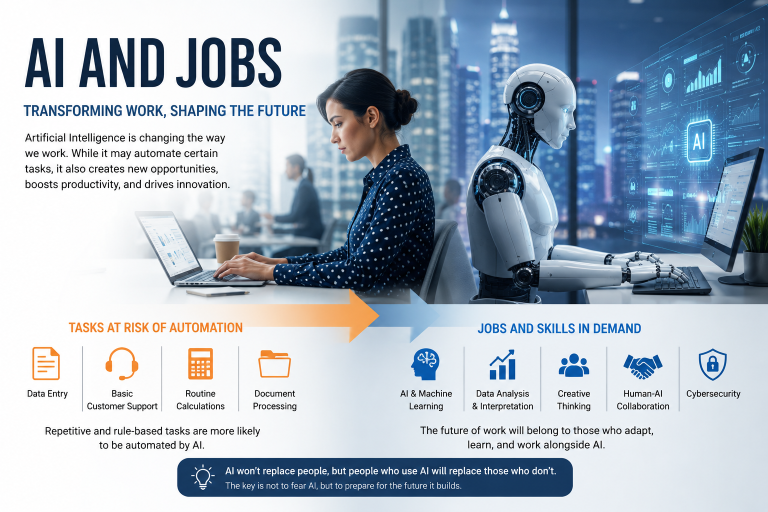
AI is great at handling large amounts of data and creating standard outputs. Therefore, jobs that are routine in nature are most vulnerable.
- Administrative and clerical roles—like data entry, scheduling, and taking meeting notes—are tasks AI can handle easily. The role of traditional secretaries and office clerks is being replaced by digital assistants and integrated tools.
- Basic customer support is also affected. While high-level conflict resolution still needs a human touch, frontline support tasks are being taken over by chatbots. These AI systems can now understand nuance better than their old, rigid counterparts.
- Routine financial tasks, such as bookkeeping, simple tax preparation, and basic financial analysis, depend on applying rules AI can now do these tasks faster and with fewer errors than humans.
- Content creation in entry-level areas, like SEO writing, product descriptions, and basic translation, is also being handled more easily by large language models. The market for generic content is shrinking quickly.
For people in these sectors, the chance of being replaced is real.
The big challenge is managing this change so those in shrinking fields aren't left behind as the rest of the economy moves forward.
As AI makes intelligence cheaper, the value of uniquely human qualities will rise.
AI can handle supply chains, but it can’t care for an employee in distress, inspire a disengaged audience, or make morally complex decisions. The future economy will focus on human skills that are hard to replace. These are the "Three Cs": Creativity, Complex Judgment, and Compassion.
Creativity isn’t something AI can truly invent It can combine existing ideas, but true creativity—bringing together unrelated fields to create something new—remains human. An architect using AI to test structures is augmented, but one who designs something entirely new is creatively human.
Complex judgment involves making decisions in uncertain situations, interpreting context, and acting based on ethics, not just efficiency. An AI can summarize a legal case, but the final ruling requires understanding the spirit of the law and the broader context, something an algorithm can’t do. High-level leadership, political diplomacy, and corporate strategy fall into this category.
Compassion and emotional intelligence are hard for AI to replicate. People want a human touch in moments that matter. Patients prefer a doctor who is empathetic, not just a screen showing results. Students learn better from a mentor who understands their emotional struggles. Caregiving jobs—like healthcare, social work, therapy, and education—will become even more important, not just bigger in number. A machine might take care of us, but only a human can care about us.
The Re-skilling Revolution: Our Urgent Mandate
The understanding that AI will change how we work leads to one clear idea: the main economic focus of our time should be helping people learn new skills and keep learning throughout their lives. If the time a skill stays useful is getting shorter, the only way to survive is to be adaptable. Our current way of learning—where we study hard for the first 25 years of our lives and then use that knowledge for the next 40—is no longer working. We need a learning system that is flexible, easy to access, and always ongoing. Companies should stop seeing training as just a cost and instead treat it as a valuable investment. Governments should move away from just giving unemployment benefits and instead support policies that help workers who lose their jobs get new skills.
Reskilling isn't just about teaching everyone to code—because AI is already learning to code. It's about teaching how to work with AI in a team. For example, how does a marketer use AI to get the best ideas for a campaign? How does a quality control worker check if AI results are biased? How does a healthcare manager use AI to handle tasks so humans can focus on patient care?
The worker who will succeed in the future isn't the one who knows the most, but the one who can best organize information and manage machines effectively.
Conclusion: A Choice, Not a Destiny
The story of AI and jobs is still being written. The idea that AI will create an economy where only a few very productive people thrive and many others are left behind is a dark future that we can avoid. This isn't something that will happen automatically because of technology—it's a possible result of not taking control of how AI is used.
If we use AI in a thoughtful way, it can take over boring tasks, make high-level knowledge more available, and increase productivity to the point where we can have shorter work weeks and better lives. It can help us move away from being just parts of an information system, giving us time to be more creative, more thoughtful, and more caring.
The future of work is a choice we make. We must choose to invest in people, see AI as a tool to help us, and manage the shift in the economy wisely. The biggest threat isn't that AI will become too powerful and replace us, but that we won't keep developing the qualities that make us human. The rise of machines doesn't have to mean the end of humanity—it can be the start of our full potential if we guide it properly.